Table Of Content
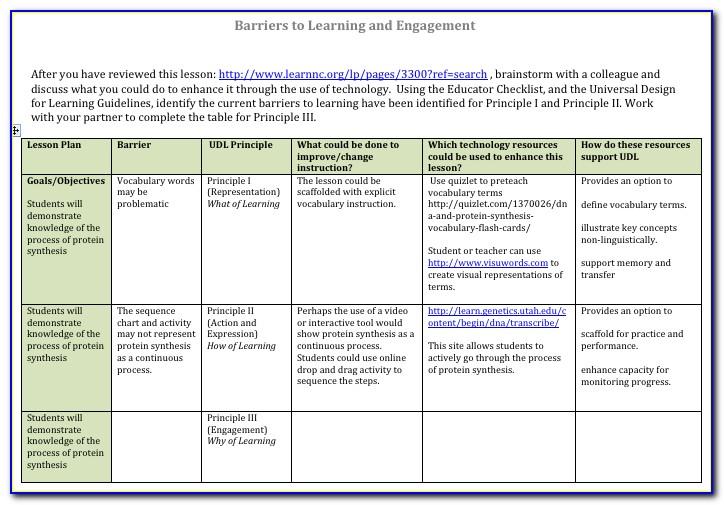
Essentially, the idea is that anything created with universal design should be designed to be used by all (hence the term “universal”). An example of this principle is a remote control with buttons that are labeled with basic language and symbols that are easy to understand. Color-contrast dishware with steep sides that assists those with visual or dexterity problems are an example of universal design. Anyone can use the dishes, and more people can use this than a flat plate. Allow students to demonstrate their understanding through different modes (writing, speaking, creating, etc.). Finally, one of the best ways to use UDL in your classroom is to encourage student participation.
People to Follow
Give students opportunities to interact with the content differently through movement, drama, art, and music. It also allows students to express themselves through writing, speaking, and signing. If your library doesn’t have the resources to completely redesign spaces, these principles can be implemented in other ways. At Brooklyn Public Library (BPL), the Inclusive Services department has been following these concepts for all of its programs. Carrie Banks, supervising librarian for Inclusive Services, says, “We don’t even think about it anymore.
Criticisms of Universal Design for Learning
Technical equipment with UD features can also help employers create a welcoming workplace. For example, phones are increasingly designed with simpler interfaces, larger buttons, handsets, and shoulder braces. Cell phones often have voice recognition technology for those who have difficulty using standard buttons, or simply find it more convenient, especially while driving or typing. Manufacturers are now integrating UD principles into their newest products, making it easier for businesses to meet the diverse wants and needs of their employees and customers. Using these products can give employers a competitive advantage — by increasing efficiency and attracting top talent seeking to use state-of-the-art technology.
Guidelines for Simple and Intuitive Use
While universal design for learning offers a great vision for accessible education, it’s often critiqued as being too unrealistic. After all, the amount of differentiation required for every single lesson seems almost impossible. Universal design in housing consists of creating a home with elements that all people can use equally. This may mean spacious halls and doors for wheelchair users and no step-ups for those with mobility issues.
Application
These changes make it easier for people with limitations, whether that's reduced physical movement while recovering from a surgery or using an assistive mobility device daily, while also increasing usability for children. Here, we'll cover key areas of universal design that work together to embrace multiple generations and abilities under one roof. Universal design (UD) is not a fad or trend but an enduring design approach grounded in the belief that the broad range of human ability is ordinary, not special. Supported by the Goals of UD, UD addresses barriers faced by people with disabilities, older adults, children, and other populations who the design process typically overlooks. Commercial buildings should include accessible restrooms with features such as grab bars, lowered sinks, and wide stalls to accommodate wheelchair users and those with other mobility impairments. By fostering inclusivity in public spaces, the universal design contributes to developing vibrant, diverse communities where everyone can enjoy the benefits of social interaction, recreation, and cultural enrichment.
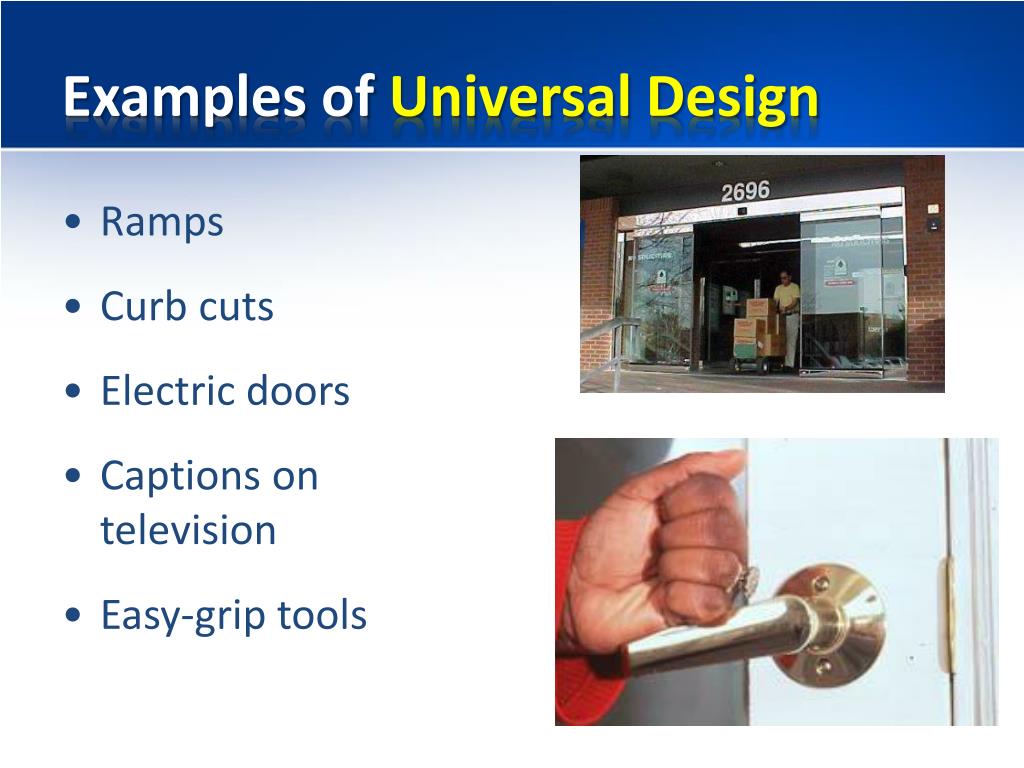
This can be particularly beneficial for individuals with cognitive or sensory impairments and older adults who may struggle with managing multiple devices. Ensuring that commercial buildings have accessible entrances, such as ramps or automatic doors, makes them more welcoming to customers with disabilities or mobility impairments. Adjustable countertops and cabinetry can accommodate users of various heights and abilities in kitchens and bathrooms.
For Further Study of the UD Framework
20 Accessibility Products You Should Know - Built In
20 Accessibility Products You Should Know.
Posted: Wed, 18 May 2022 07:00:00 GMT [source]
You can design superb interactive experiences by adding appropriate keyboard shortcuts. They will improve the navigation and make websites easier to use for all users. TED is a non-profit organization, which is dedicated to spreading ideas via short power talks. The talks are usually 18 minutes or less and are often uploaded as videos on their websites.
Eliminate Barriers by Universal Design for Learning
The products should have a certain level of error tolerance, this is done to reduce the harms and adverse consequences caused due to unintended actions. The placement of the kitchen’s cooktop is decided in such a way that it remains accessible to everyone. Shouldn’t be too high for children, people in a wheelchair, shouldn’t be too low for normal people.
The Seven Principles of Universal Design
By including users with disabilities early on, you ensure you consider their needs and cater to them in full, rather than revisit them later with adjustments to your initial release. Examples of universal design for learning include the use of flexible workspaces, accessible digital texts, and student choice throughout learning experiences. The scope of applications of UD in Higher Education (UDHE) includes all products and environments that directly or indirectly support teaching and learning in higher education. Examples of more narrowly defined scopes are applications of UD to online learning, informal science learning, student services, IT, or physical spaces. Everyone, regardless of physical, cognitive, or learning ability, age, or circumstances, should be able to use and enjoy a product or environment.
By considering the spatial requirements of a diverse range of users, designers can create environments that are comfortable and accessible to everyone. Examples include ample turning space for wheelchair users, reachable shelves and cabinets, and knee clearance under countertops and desks. Originally developed in response to the needs of the aging population and people with disabilities, UD has much broader applicability. UD increases ease of access to products, places and services for multiple, diverse populations. Using UD means that facilities, programs, and services take into account the broad range of abilities, ages, reading levels, learning styles, languages, and cultures in their diverse workforce and customer base. While diversity brings experience, perspective, and stability to a workplace, it also means that employees and customers have a wider variety of needs and expectations.
So as to reduce complexity and reduce cognitive loads, you should always aim to present information between 3 and 9 items. The Principles of Universal Design is a foundation for designers who set out to create Universal Design products. The principles were created to guide a wide range of design disciplines including environments, products, and communications. You can apply these principles to any design style or trend; they are timeless and adaptable. You will be proactively taking on accessibility by incorporating these principles at the beginning of a project. The innovative solutions for Universal Design (isUD) program launched in 2018.
Second, it focuses on finding one solution that will function equally for everyone, rather than fragmented approaches that divide users. The most important international work on accessibility is the Convention on the Rights of Persons with Disability (CRPD). We refer to it as the Convention by lawmakers and the disability community. It is the first major human rights treaty of the 21st century, and it protects the rights and dignity of persons with disabilities.
The flexibility built into this approach simultaneously provides a better learning experience for all students and offers a way for students with disabilities to participate without special accommodations. This principle demonstrates the necessity for designs to offer suitable dimensions and spatial allowances, i.e. building restroom stalls that accommodate wheelchairs. In terms of a website or application, this might involve creating buttons and other interactive features that are adequately large and spaced apart, facilitating easy clicks or taps regardless of the user’s device or chosen means of input. This means the design should be adaptable and accommodate flexibility for the user. In a digital context, this involves designing interfaces that can be used in multiple ways, aligning with user preferences. This could include allowing the customization of text size, color contrast, or the ability to navigate via keyboard or mouse.
Reviewers ensure all content reflects expert academic consensus and is backed up with reference to academic studies. Dr. Drew has published over 20 academic articles in scholarly journals. He is the former editor of the Journal of Learning Development in Higher Education and holds a PhD in Education from ACU. Nevertheless, features like the opportunity to access personalized digital texts and multiple teachers does face a range of barriers – not least of which begin funding pressures.
High-contrast color schemes can also enhance the overall aesthetic appeal of the space, creating a visually engaging environment for all users. By eliminating steps and providing a smooth, level entrance, zero-step entrances ensure easy access to homes for wheelchair users, people with mobility impairments, and those with strollers or wheeled luggage. As the global population ages, the demand for age-friendly environments is increasing.


No comments:
Post a Comment